Showing posts with label Education. Show all posts

Thursday, February 26, 2009

"The Great Vowel Shift"

Anybody learning English and struggling with our ridiculous spelling/pronunciation can, to some extent, blame "The Great Vowel Shift". Between the 1400s and 1700s, English pronunciation was totally revolutionised. It happened astonishingly quickly and it is not completely clear why:
The upshot has been that the Anglo-Saxons lived (like the Scottish still do) in a 'hoose', and the English live in a 'house'; the Anglo-Saxons (like the Scottish) milked a 'coo', and the English milk a 'cow'; an Anglo-Saxon had a 'gode' day and the English have a 'good' one; an Anglo-Saxon had 'feef' fingers on each hand and the English have 'five'; they wore 'boats' on their 'fate' while the English wear 'boots' on our 'feet'.
Some theories have it that the massive population movements into the South East of England after the Black Death may have led to the shift, with regional accents mixing with and influencing that region's standard pronunciation. There was also great social mobility in and around London following the plague, allowing previously marginalised pronunciations to influence the standard speech of a region that has since huge influence on accepted English. Others argue that the dropping of French by aristocrats in England may have influenced pronunciation. The toffs may either have tried to create their own posh accent more on the French model or, conversely, attempted to speak English in a way they felt was further from French (because France was an enemy).

The shift may be continuing. How do you pronounce "route"? Some Americans can rhyme it with "out". The English are still mired in a distinctly Anglo Saxon "boot". Anyway, all this change is one reason why English spelling is such a nightmare. It was standardised during this shift and therefore has little or no reliable connection to actual pronunciation. For more on that, see "ghoti" and English spelling reform.

Monday, February 09, 2009

Art history

A very good online course, with lots of vids.

Wednesday, January 21, 2009

Monday, July 02, 2007

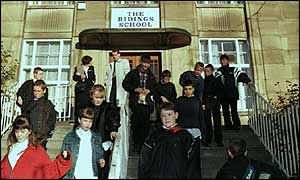
Ridings School closure

It seems the Ridings school is likely to close. I have written about the wider issues surrounding the Ridings before on this blog and I broke the original story about the Ridings when I was a cub reporter.

I am going to make a radical suggestion. The pupils have been let down by gutless politicians (most notably, as I talked about in my previous post, at a national level). They are to be transferred to other schools. Which schools? Well, of course, this is a one off situation, outside the ambit of the destructive 11 plus system which dominates Halifax education. So why not send them all to two of the closest secondary schools: The Crossley Heath School and North Halifax Grammar School, which just happen to be the two selective schools in Halifax?

Just let me pessimistic and cynical for a second. I have a sneaking feeling that not a single boy or girl will end up in either of those schools even though all the other schools that will be doing their bit to accommodate the pupils will be breaking their entrance procedures to allow them in. Because, you see, the whole point of Grammar Schools is to keep the oiks out.
Update: The more I look at this, the more outrageous the conduct already seems to be. Is the gutless procedural amorality never going to end? Here it is in black and white from the councillor in charge of education in Halifax: "Children attending The Ridings are not receiving an adequate standard of education." Let's quit the fannying around and say there is now no doubt that the school will close. Absolutely no doubt. The Pope will take to wearing Ra-Ra skirts, a thong and leg warmers before this inevitability will be reversed. (Hey, maybe he does?) They have to consult but it is over. The unions, the councillors, the central education institutions are just dancing a last tango, playing their prescribed roles.

And yet, correct me if I have read this wrong, they are going to recruit an intake of pupils into the Ridings this September! Into the school where the head councillor freely admits they will not receive an adequate education. And they are going to leave them there not for one year, when they will shut it off to new entrants, but two years! And don't tell me the situation is not going to get worse in the Ridings in that time. And then what? Off to the Halifax High School for a bit of a race riot?

Perhaps I am just a little naive. Perhaps the "procedures" mean you cannot possibly do an emergency redistribution of pupils at this late stage of secondary admissions. Perhaps it would lead to court cases from teachers at the Ridings saying the decision had not properly been consulted on? Perhaps there would be a bit of a squash in the classrooms of the receiving schools. I don't know. But surely this is a situation where the councillor should, as someone once memorably said, put his "nob on the block" and make a brave decision and try to get the Halifax head teachers together to do something right.

Thursday, February 01, 2007

Tokai University intensive Japanese course

I was pleasantly surprised to learn that the Times Higher Educational Supplement (THES) 2006 university rankings have assessed Tokai University as the third best private university in Japan. I have just completed a pretty good intensive Japanese course at Tokai but have to admit I was a little taken aback by Tokai's elite status.

Tokai is not considered a particularly prestigious university in Japan. Many other private universities like Sophia University, the International Christian University, Rikkyo, Meiji, Aoyama Gakuin and Tokyo University of Science would take it for granted that they would be ranked well ahead of Tokai. Isn't it refreshing to have university rankings that are not hidebound by snobbery and received wisdom and instead strike out on their own with new and original views of the the university scene? Certainly refreshing if you have a newly minted certificate from one of the newly elevated! Hooray!

The style of my "bekka", which was a one-year pre-entry intensive Japanese course and was not at degree level, was quite school-ish rather than university-ish. I mean by that that there was a lot of rote learning and not a lot of thinking or broadening of the horizons of the students. That was a reflection of the nature of the course as a pre-entry preparation for university study and I cannot judge the quality of the degree level education. The staff ratio on the Japanese Language Course for Foreign Students was pretty good, about 8 to 15 students in the classes and the teachers were all professional. About half of my teachers were really first rate at what they did.

While I am at it, I might as well mention that Tokai's massive advantage over any of the often more prestigious Tokyo institutions is the extreme cheapness of some of its accommodation. Many of the bekka students were paying something like 10,000 yen per month for admittedly very basic rooms. That is unimaginably cheap for these parts. There is a good deal of this kind of accommodation at the Hiratsuka campus at least. It is within fairly easy striking distance of Tokyo and is a nice enough environment itself.

Saturday, November 19, 2005

Hold the front page! The Ridings School is rubbish shock!


I hear the Ridings school is back in trouble! Interesting that because, in reality, it never was out of trouble.

Some of you may wonder what I am talking about. Way back in the dim and distant past, when I was a cub reporter on the Halifax Courier, I broke a story about chaos at the Ridings School in West Yorkshire which became big national news. Basically, the kids were rioting and the academic results were absolutely abysmal (only 8 per cent of children got 5 A to C grades). The national newspapers followed up my story and had a field day, labelling it the "School from Hell", "The Worst School in Britain", and "Grange Hell".

The Ridings was closed down, its leaders were chucked out and it was reopened under a new and charismatic joint headship. The story ran for months and became the focus for a national debate about failing school leadership. This approach, that schools were bad because their leaders were bad and that schools could be saved by new leadership, has defined the Labour Government's basic approach to education policy since. Tony Blair is particularly attached to it. I once heard him say he could tell how good a school was without even entering it, but simply from his first impressions of the head teacher. What a load of toss!

Anyway, the media have periodically revisited the Ridings in the decade since it became infamous and have told a heart warming story of a struggle against the odds, in which charismatic leaders have dragged a down-and-out school from the depths to something approaching respectability. Millions of pounds have been poured into this flagship project. The two headteachers who took the helm after the Ridings disgrace, Peter Clarke CBE and Anna White CBE, have been hailed as heroes and showered with plaudits and honours for "turning the school around". Successive education secretaries and Blair himself have made numerous visits to the school to trumpet this example of how the worst can be made, if not into the best, then into the just below average.

So how shocking to read that headline on the BBC website this week: "Ridings School 'inadequate' again"! The article continued breathlessly:
The Ridings School in Halifax has been given notice to improve after Ofsted inspectors said it was "performing less well than could be expected". The report said pupils were disruptive and capable of achieving more, and that teaching quality was "variable".But it praised the new head teacher and leadership team, saying they had made good plans to raise standards.
Well, as the person who broke this story, I must say I'm not surprised at all that the Ridings school is inadequate "again". The plain fact is that it always has been inadequate and always will be. All this talk about great leadership, while no doubt true, has completely missed the point.

That terrible 8 per cent of students getting 5 GCSE A-Cs became 6 per cent in the year after the "rescue" of the school, then 3 per cent. Fair enough, you might say. This might be put down to the inadequacies of the old regime playing themselves out. But never, between 1996 and 2003 did the number of good GCSEs top 13 per cent. Then, in 2003, a great set of results: 25 per cent good grades! Still absolutely appalling by national standards, but an improvement. Head teacher Anna White said this marked the "long-awaited turning point". To mix metaphors, the turning point seems to have been a false dawn. Last summer, the figure was back down to 14 per cent. The Ridings never was "the worst school in Britain". However, despite the nice fairytale the Government and parts of the media have told in the decade since it was "rescued", it always has been a poorly performing school.

Why? The real issue was and is that the structure of education in Halifax inevitably means that the Ridings will always be in the Doldrums. A vicious selective education system exists in the town. It is a small place with two grammar schools in it and a hierarchy of schools beneath them, which exist to cater for the various grades of "failures" who didn't get into the flagship schools. We are not just talking a "Grammar School" and "Secondary Modern" system here; we are talking "Grammar School" and then "Secondary Modern, level 1", "Secondary Modern, level 2", "Secondary Modern, level 3" ... etc. etc... and then "The Ridings" at the very bottom of the pile. That is a bit of a caricature, there is a bit of localism in the system, but I think it catches the flavour of what is going on. The Halifax situation is particularly vicious because the size of the town means anybody can try to attend any school, but the elitism is the same as with any selective system. The grammar schools raison d'etre is to reproduce success. They take the best children, mix them together in an elite environment, and their results are excellent. The Ridings, at the very bottom of the hierarchy, is arguably set up to fail, to safely accommodate "failing children" for five years well away from the children who have some hope of success. Of course there are children in this group who have tons of potential but any success they do achieve is really remarkable in the Ridings context. The Ridings takes these worst performing children at 11-years-old, mixes them together with no sight of any students who were in any way successful at that age, and its results are terrible. Surprise! Surprise!

If people want to do something about the quality of education offered to the children of Halifax, they should quit looking at the leadership of the Ridings and start looking at the grammar school just 300 metres down the road from it and the other one about a mile away. They should ask themselves whether, in a small town with such a hierarchical structure of education, we can ever expect the school(s) at the bottom of that hierarchy to be any good? The stuck record that is the Ridings story suggests not.

The problem is that looking at such structural issues requires good leadership at the highest level, ie. national politicians. In truth, the leadership at that level on this issue has always been "inadequate". They have, quite consciously, avoided making any decision on an issue that would be politically problematic. Like any bad head, they have avoided the difficult call and preferred to blame their underlings for poor performance.