Monday, February 28, 2005

Evil aesthetes

The critic Terry Eagleton once wrote something to the effect that the fact that many Nazi death camp officers spent their time reading Goethe and listening to Mozart put a bit of a dent in the old assumption that consuming beautiful art was morally improving. It is arguable that the Nazi regime was one of the most "aesthetic" in history and, perhaps partly because of that, one of the most evil.

Anyway, Eagleton's observation was brought to mind in the second chapter of Hochschild's book:

"Oswald, as he appears in protraits had a long, determined face, intense eyes, and a proudly bowed-out chest. His contemporaries saw him as a wise, thoughtful man who embodied Scottish virtues of frugality, sobriety, and hard work, and who spent all of his spare time reading, often far into the night. He supervised the construction of a home library with sliding glass panels that contained more than two thousand books fo theology, philosophy, literature and history. His art collection included works by Rubens and Rembrandt, and a friend called him a 'man of Great Knowledge and Ready Conversation'. Among those who shared that conversation at his London dinner table, or could hunt pheasants while visiting his 100,000 acre estate in Auchincruive, Scotland were Benjamin Franklin and the writers Laurence Sterne and James Boswell. Oswald played a major role in Scottish road building, gave to charity and, as we shall see, would represent his country on a crucial diplomatic mission"


He was also one of the most successful slave traders of his time.

The other major character in Hochschild's chapter is John Newton, a slave boat captain who spent half his life chucking dead people off his boat during the immensely cruel voyage from Africa to the Americas and the other half as a self-professed religious man, chafing at the immorality (by which he meant licentiousness) of his fellows. Newton spends much of his journal thanking God for miraculous interventions in his life and for signs showing the way to conduct himself and yet:

"...during the better part of a decade in the slave trade, and for some thrity years afterwards, John Newton seems never to have heard God say a word to him against slavery."


In my piece in "Big Questions in Science" I was asked to look at the science of aggression. At the end of my research, it became apparent that the most destructive forms of man's inhumanity to man could not be explained in terms of our innate aggressive drives. Phenomena like the Holocaust, the slave trade and 9/11 have really rather little to do with man's violent or aggressive feelings, but much more to do with our incredible ability to disengage our moral faculties and, more fundamentally, our sympathetic/empathetic feelings when it suits us. Perhaps art/religion serves as a way of filling the gap sometimes.

The first international human rights movement


Reading "Bury the Chains" by Adam Hochschild, an account of the campaign for the abolition of slavery. In a gripping first chapter, Hochschild quotes "the first and greatest student of what we now call civil society" Alexis de Tocqueville: "[The campaign was] absolutely without precendent ... If you pore over the histories of all peoples, I doubt that you will find anything more extraordinary."

Monday, February 21, 2005

Islam


Read "Introducing Islam" by Ziauddin Sardar and Zafar Abbas Malik in the bath today (it got shivering cold). The style of the "Introducing" series, produced by www.iconbooks.co.uk, is very much like a cross between a child's text book and a comic book. Everything is very clear, without jargon, and surrounded by cartoons and pen drawings. The innovation is that they tackle some really pretty abstruse topics - "Introducing Semiotics", "Introducing Quantum Theory", "Introducing Critical Theory" etc.. Apparently the series has been around for ages and I do vaguely remember picking them up and rejecting them as too simplistic a few times in bookshops. However, my real introduction came a few weeks ago when I was trying to quickly reintroduce myself to Marxism. I bought "Introducing Marxism." Brilliant. In fact, sad to say, it made a bigger impact on me than any book on Marxism I have ever read, except perhaps the Communist Manifesto. (Why didn't Engels do a few cartoons?)


Back to the book on Islam. At first, I found it a bit hard to like because the start was a retelling of the life of Mohammed. It felt a bit like the children's text books I compared the series to earlier. But the middle and end were gripping. It describes in detail the debt Western civilisation owes to Islamic civilisation. The fact that Islam preserved and built upon the legacy of classical rationalism through a period when Europe had its mind on sheep rustling, building much of the foundations of medicine, maths and science: "Five hundred years before Galileo, Al Baruni discussed the rotation of the earth on its axis and Al-Battani measured the circumference of the earth" . This much I already knew, but the book goes into great detail about the precise nature of the intellectual debates among muslims during this golden age and the religious roots of its intellectual energy. But the bit that kept me in the bath was the final description of the modern experience of Islam. It is unblinking in its description of the traumatic experience of being colonised and the West's often rapacious conduct towards Islamic civilisation from the time of the Crusades. However, there is no attempt here to absolve Islamic civilisation for responsibility for its own troubles. We are introduced to an apparently rather lively debate within Islamic civilisation about its own renewal. The book introduces thinkers such as Malek Bennabi, an Algerian social philosopher: "The real liberation of Muslim people, Bennabi argued, will come from addressing the injustices introduced in the thought and body politic of Islam in the late 13th Century."

What a pleasant surprise it was to read the first sentence of the section on "women": "Traditional Muslim thought has been very unkind and oppressive to women". Of course, it is not expounding the kind of ill-informed bollocks which insists that somehow Islam is fundamentally unfriendly to women, but it is not indulging in the boring and unsatisfactory response to that which is that Islamic societies are somehow models of unsexist behaviour, which is manifestly not true.

I shivered from the bath wondering about the interesting contrast between Islamic civilisation's early history, when it was so confident that it ravenously consumed the best that classical civilisation and any other civilisation had to offer, and the lack of confidence among some muslim societies now, which are seeking to purify themselves of the admittedly very unclean West.

Sunday, March 05, 2000

Tenmasen Kanji

Monday, January 31, 2000

Posts began 2005. Odds and ends archive follows.

I use "2000" as a storage place for posts which are not part of the mainstream of the blog. I began posting to this blog in February 2005.

Some of the posts in "2000" are linked to from other pages. I have also archived some deleted or replaced material.

Saturday, January 29, 2000

Dennett

This is a bit of a stream of consciousness, but I wanted to note my thoughts down:

Dennett's lecture partly relied on an analogy between what he called "ideas to die for" and the ant driving parasite. Part of the impact of this comparison was the idea that the parasite was a foreign invader, fundamentally separate from the host ant. The problem when trying to make a comparison between this relationship and the relationship between humans and ideas is that, in an important sense (perhaps the most important sense), humans are made of the ideas that drive us. They are not alien bodies invading us, they are us. Dennett seems to nod to this at another point in the lecture. I don't feel that the parasite is controlling me like an ant, I feel I am a collection of such parasites. It is not that the facts of what Dennett was saying were wrong, it is just that, after a bit of thought, I started to feel that a large part of the lecture's impact came from overstretched analogy between biology and the world of ideas. There seems to be a tradition of "social biology", in which biological science claims to bring deep insights into the study of human relations. Social Darwinism was a very influential manifestation of this. The problem though always seems to be that, in the end, all the biological model is is an analogy. It might prompt a bit of fresh thought, it might even be inspirational, but like all analogies it will not fit properly in some places. No amount of talk of ant driving parasites is going to itself give really valuable detailed insights into the nature of the Catholic Church, just as no amount of study of the Catholic Church will give new information on ant driving parasites. It seems trivially, obviously true that ideas/institutions/ways of thinking exist, just like anything in the world, because they have survived/replicated in the environment in which they have occured. Isn't that kind of obvious? Haven't we always known that? In this case, there is a lot of natural selection going on but there is also a good deal of intelligent design. So the analogy starts to stretch. If you want to get deeper into this you have to study ideas as ideas, not as analogies of biological objects, and that is what history, literature, political studies etc is all about. Presumably the interest in the biology of the ant parasite for the serious biologist is really in the detailed understanding of the interactions of chemicals, strategies etc. etc that allow it to exist and allow it to do what it does, rather than in the bald statements of the parasites existence that we find in Dennett's lecture . The same goes for an institution like the Catholic Church. The political/social analysis in Dennetts lecture was about as insightful as his generalised biology.

Friday, January 28, 2000

RSS

This is not a technically correct description but, in my mind, RSS is basically a system by which you can subscribe to a feed from a website. You don't have to go to the website and check whether it has been updated, your feed reader will tell you it has been updated and provide direct links to the new content.

I found the BBC's introduction to RSS very clear on this.

Your feed reader could be a bit like Microsoft Outlook (a downloaded program on your computer) or it could be a feature on your internet browser (Firefox already does this and I think the next version of Internet Explorer will). However, I prefer service called Bloglines because it is web based, so I can access it from anywhere. Google has a similar reader. The simplest introduction to RSS is signing up to a www.my.yahoo.com and sticking a few rss feeds onto your homepage. Although this method means it is difficult to process large numbers of web feeds, it is more like a traditional newspaper in that it feeds news onto a laid out page.

Basically, in all of these programs, you click on a link (or input a url) to an RSS feed and it somehow zaps it into your RSS reader and forever more you have a feed available on your reader monitoring updates to that site. This site, for instance, has a RSS feed here and a Japanese news feed here.

Tuesday, January 18, 2000

Rant picked up

My rant about Japan's war guilt has been picked up by ikjeld.com, a Japanese news website run by a Japan based journalist called Kjeld Duits. I'm rather chuffed. It was not really written as a professional piece, but there is something deep in the journo's psyche that wants everything they write to be read by the maximum number of people possible.

He has a really interesting article about Okinawa's experience in the war.

Update

It was picked up from ikjeld.com by Topix.net, an internet news aggregator. It was the second item in their Japan newsletter (the links don't work):

From: "Topix.Net News Alerts"
Date: August 18, 2005 11:22:11 PM JST
To:
Subject: Topix.net News Alert for Japan

News alerts for Japan (brought to you by Topix.net)

Top Stories (For all articles, visit Topix.net):

Hotel operator Hashiba set to run against Koizumi in poll
MSN-Mainichi Daily News (Thursday August 18, 2005)
Hideyoshi Hashiba, president of a hotel in Goshogawara, Aomori Prefecture, may run in the upcoming House of Representatives election in the Kanagawa Prefecture's No...
http://www.mdn.mainichi-msn.co.jp=2Fnational=2Fnews=2F20050818p2a00m0na019000c.html

War Guilt
IKjeld.com (Thursday August 18, 2005)
There was a fascinating account on Japan's Kyodo newswire at the end
of last week of a visit by a group of British school children to Japan
to commemorate the end of the war.
http://www.ikjeld.com=2Fjapannews=2F00000216.php

Tokyo Electric Says Some Radioactive Water Leaked At Reactors After
Quake
Bloomberg (Thursday August 18, 2005)
Tokyo Electric Power Co., Asia's biggest power producer, said some
radioactive water spilled from storage pools into ventilation systems
of three nuclear reactors because of an earthquake that shook Japan
two ...
http://www.bloomberg.com=2Fapps=2Fnews=3Fpid=3D10001099=26sid=3Da
BlIuqJwyewE=26refer=3Denergy

Briefing - Asia Health - Aug 18, 2005
Asia Pulse via Yahoo (Thursday August 18, 2005)
An executive briefing on Health for Aug 18, 2005, prepared by Asia
Pulse , the real-time, Asia-based wire with exclusive news, commercial
intelligence and business opportunities.
http://Fsg.biz.yahoo.com=2F050818=2F16=2F3ubxh.html

The Korea Herald : The Nation's No.1 English Newspaper
Korea Herald (Thursday August 18, 2005)
My father and four of my uncles fought in the Pacific campaign against
the Japanese.
http://www.koreaherald.co.kr=2FSITE=2Fdata=2Fhtml_dir=2F2005=2F08
=2F19=2F200508190007.asp

For all the articles on Japan please visit topix.net
http://www.topix.net/world/japan/


Sunday, January 16, 2000

Thursday, January 13, 2000

Maiko

Barack Obama Against Going to War with Iraq, Oct. 26, 2002

Remarks of Illinois State Sen. Barack Obama Against Going to War with Iraq

Speech by Barack Obama
Delivered Oct. 26, 2002
(Linked from this main Buyo post. The date on the top of this post is misleading. I just filed it in 2000 to keep it out of the mainstream of the blog)

I stand before you as someone who is not opposed to war in all circumstances. The Civil War was one of the bloodiest in history, and yet it was only through the crucible of the sword, the sacrifice of multitudes, that we could begin to perfect this union and drive the scourge of slavery from our soil.

I don't oppose all wars. My grandfather signed up for a war the day after Pearl Harbor was bombed, fought in Patton's army. He fought in the name of a larger freedom, part of that arsenal of democracy that triumphed over evil.

I don't oppose all wars. After September 11, after witnessing the carnage and destruction, the dust and the tears, I supported this administration's pledge to hunt down and root out those who would slaughter innocents in the name of intolerance, and I would willingly take up arms myself to prevent such tragedy from happening again.

I don't oppose all wars. What I am opposed to is a dumb war. What I am opposed to is a rash war. What I am opposed to is the cynical attempt by Richard Perle and Paul Wolfowitz and other armchair, weekend warriors in this administration to shove their own ideological agendas down our throats, irrespective of the costs in lives lost and in hardships borne. What I am opposed to is the attempt by political hacks like Karl Rove to distract us from a rise in the uninsured, a rise in the poverty rate, a drop in the median income, to distract us from corporate scandals and a stock market that has just gone through the worst month since the Great Depression.

That's what I'm opposed to. A dumb war. A rash war. A war based not on reason but on passion, not on principle but on politics.

Now let me be clear: I suffer no illusions about Saddam Hussein. He is a brutal man. A ruthless man. A man who butchers his own people to secure his own power.... The world, and the Iraqi people, would be better off without him. But I also know that Saddam poses no imminent and direct threat to the United States, or to his neighbors...and that in concert with the international community he can be contained until, in the way of all petty dictators, he falls away into the dustbin of history.

I know that even a successful war against Iraq will require a U.S. occupation of undetermined length, at undetermined cost, with undetermined consequences. I know that an invasion of Iraq without a clear rationale and without strong international support will only fan the flames of the Middle East, and encourage the worst, rather than best, impulses of the Arab world, and strengthen the recruitment arm of al-Qaeda.

I am not opposed to all wars. I'm opposed to dumb wars. So for those of us who seek a more just and secure world for our children, let us send a clear message to the president.

You want a fight, President Bush? Let's finish the fight with Bin Laden and al-Qaeda, through effective, coordinated intelligence, and a shutting down of the financial networks that support terrorism, and a homeland security program that involves more than color-coded warnings.

You want a fight, President Bush? Let's fight to make sure that...we vigorously enforce a nonproliferation treaty, and that former enemies and current allies like Russia safeguard and ultimately eliminate their stores of nuclear material, and that nations like Pakistan and India never use the terrible weapons already in their possession, and that the arms merchants in our own country stop feeding the countless wars that rage across the globe.

You want a fight, President Bush? Let's fight to make sure our so-called allies in the Middle East, the Saudis and the Egyptians, stop oppressing their own people, and suppressing dissent, and tolerating corruption and inequality, and mismanaging their economies so that their youth grow up without education, without prospects, without hope, the ready recruits of terrorist cells.

You want a fight, President Bush? Let's fight to wean ourselves off Middle East oil through an energy policy that doesn't simply serve the interests of Exxon and Mobil.

Those are the battles that we need to fight. Those are the battles that we willingly join. The battles against ignorance and intolerance. Corruption and greed. Poverty and despair.

Monday, January 10, 2000

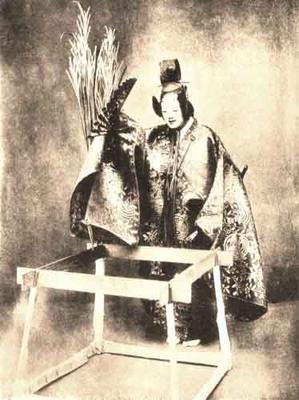
Izutsu


Izutsu (or "The Well Side) was written by Zeami, the dominant figure in the early history of Noh. It is one of the classics in the Noh canon.

Izutsu is based on an old story from the Ise Monogatari, a 9th century collection of stories, many of which are based on stories about the romantic encounters of a "certain man", traditionally identified as the poet Ariwara no Narihira.

Zeami's play starts with a priest arriving at a ruined aristocratic house. A village women arrives to tend the graveyard in the house and, as he watches her, the priest becomes intrigued. He asks her why she is tending the grave and she says there is a story behind the place. She begins to tell the story from the Ise Monogatari:

A man and a woman knew each other from early childhood. They were good friends, competing against each other to see who was taller by measuring each other against the local well. As they grew older, they began to feel more self-conscious in each other company and drifted apart.

The boy eventually realises how beautiful his childhood friend has grown and composes a poem saying only that he has grown tall while he hasn't seen her. She replies that her girlish hair has grown past her shoulders :"If not you, who'll do it up for me?"

They get married. The man later falls in love with another woman and takes to making visits to this woman's house. One stormy night, as he is leaving the marital home on one of these visits, he notices his wife, without knowing that he is looking, compose a poem saying that she is worried about his welfare on a journey on such a stormy night. It brings home to him how much he is loved and he does not go to the other woman. He never goes back.
When she has finished the story, the village woman looks at the priest and says she is the wife in the old 9th century story. She disappears. He has seen her ghost. The priests asks a village man about the place and hears the same story again. The villager suggests that, as a priest, he could offer a prayer to her soul and the priests decides to sleep at the ruined mansion. She comes to him again in a dream. This time she is wearing her husband's clothes. She dances and sings about how much she loves her husband and how much she yearns for him. She looks into the well that they had stood beside as children and sees his reflection. She then disappears.

I am no expert on Noh drama and I warn that may have got details of this story wrong but this final image in the drama seemed extraordinary. On stage, the audience at Kamakura's Takigi Noh saw a man wearing a Noh mask representing the dead soul of a woman appearing in the dream of another. She was dressed in man's clothing, and looked into the well and saw in the water, not her own face but, the mask of the man she loved beyond death. It is very multi-layered and yet, in the context of the play, strikes the viewer as such a simple expression of love.

Here is a translated text of Izutsu.

Sunday, January 09, 2000

This may make you choke on your sushi...

This article was published in the Times Higher Education Supplement, 31 May 2002. It is linked to in this post and I have taken the risk of mirroring it because it is so old and, in my opinion, so good.

Does one of the host nations of the World Cup bring to mind geishas and duty-bound businessmen? Cut the cliché, says Ayako Yoshino.

The world's greatest sporting carnival has kicked off again. Brace yourselves for a flood of goals and a torrent of cliche. Even now, the television commentators are practising their "German efficiencies", juggling their "Brazilian flairs", and drilling their "Nigerian athleticisms".

Of course, the host countries can expect their fair share of stereotyping, and Japan, where England play all of their group matches, will be the focus of particularly loving attention from the British media. It would be a wonderful opportunity to correct some stereotypes, but if past media coverage can be taken as a guide, it is probably not too pessimistic to expect numerous beautiful images of Kyoto's Golden Pavilion and Mount Fuji set against disappointingly shallow chatter about a group-oriented, homogeneous, hierarchical and highly technological society governed by concepts of shame, duty and discipline. If we are really lucky, we might even get the odd reference to "traditionally submissive Japanese women".

There will be nothing new in that. Casual stereotyping of Japan has long been a staple of the British media. It may come as a surprise to some, but the bizarre gameshow Endurance has probably been more widely disseminated in this country through Clive James's programmes than it ever was in Japan, where it was about as mainstream as topless darts was in Britain. The 1980s song "Turning Japanese" - already a fixture in the World Cup build-up - sounds puzzlingly Chinese to the Japanese ear.

But what is the real story? Ron Atkinson and Terry Venables might not notice it, but English football is visiting a country that is in the midst of the most fundamental changes not only to its economy and politics, which have been rocked since the collapse of the "bubble" stock markets of the 1980s, but to its basic ideas of itself. A new breed of Japanese academics is presenting an unsettling self-portrait to the nation, and the first targets to be attacked have been postwar theorists who described the country as having a uniquely homogeneous and group-oriented culture.

Kosaku Yoshino, associate professor of sociology at Tokyo University and author of Cultural Nationalism in Contemporary Japan , has made a study of "Nihonjinron", theories of Japanese distinctiveness, which he says became popular in postwar Japan after the traumatic experiences of devastating military defeat, vicious self-recrimination by Japanese in the immediate postwar years, rapid and enforced Americanisation, and subsequent breakneck economic growth. These theories, which often emanated from mainstream academics and were massively popular in the 1970s and 1980s, could border on the absurd: the idea that Japan's rice-growing tradition meant that the Japanese were uniquely family-oriented compared with the West's "wheat-growers", as Eiichiro Ishida argued in 1969, or the apparently contradictory proposition that the West's "hunting traditions" made for a highly analytical mode of communication as opposed to the Japanese rice-grower's emphasis on "feelings of consideration, gratitude, encouragement and sympathy, which are unnecessary for hunting", as Yuji Aida stated in 1972. There is also the rather unsettling case of The Japanese and the Jews , the bestselling book of all genres in 1970, contrasting the nomadic self-oriented Jews with the cooperative Japanese. Its author, Isaiah BenDasan, claimed to be Jewish but is widely thought to have been a well-known Japanese social critic.

"The first thing to understand about these ideas is that they go well beyond the facts. They are a faith system, which had more to do with delineating what it meant to be Japanese so it was safe for the country to absorb foreign cultural elements. Nihonjinron was an attempt to define a supposedly homogeneous Japan against an imagined homogeneous West," Yoshino explains. Many of these theories were exclusively concerned with a binary, oppositional relationship with the West, often feeding off mistaken western theorising about Japan and excluding the exploration of relationships and ties with other cultures. Japan was therefore seen as unique.

Of course, the reality never quite fitted these imaginings. Yoshino points out that, while Nihonjinron theorists celebrated Japan's "classless" society, hundreds of strikes were reported every year. Japan is also more ethnically diverse than is widely understood. The average British traveller will find it difficult to distinguish Japan's main ethnic groups, but figures in 1998 showed that there were about 640,000 Koreans in the country, 260,000 Chinese and about the same number of Brazilians, of whom large numbers were Japanese-Brazilians. There were also hundreds of thousands of Peruvians, Filipinos, Thais, Indians, Middle East nationals and westerners. Although foreigners make up a relatively small 1.2 per cent of the Japanese population, some communities found themselves with up to 14 per cent of non-Japanese inhabitants by the mid-1980s.

Many of these groups are becoming increasingly assertive. Physical differences are impossible to determine, even for the Japanese, but ethnic Koreans are now rapidly taking up their original names and rebuilding their own cultural identity. There are 86 Korean schools and colleges in the country. Japan's two main minority groups with Japanese nationality - the Ainu and Okinawans - are showing a similar resurgence.

And it is not just ethnic minorities who are challenging received ideas of Japanese homogeneousness. Japan's leading feminist, Tokyo University professor Chizuko Ueno, says: "Nationalism and sexism often go hand in hand because women are often, in fast-changing societies, made to represent culture and tradition. While men quickly adopt western suits, women are often made to remain in the traditional clothes. That's why some reactionaries attack Japanese women as the very people who destroy Japanese tradition."

It would be a major surprise if this summer's World Cup coverage did not feature a good number of that highly endangered species, the geisha. But while white-faced, tightly bound girls may remain a predominant image of Japanese womanhood abroad, Ueno's data paints a radically different picture.

The figures show that housewives are now in a minority in Japan. She says:

"Japan now has one of the lowest birthrates in the developed world, and the reason for that is simply because so many Japanese women choose not to get married. It is so visible. Even if they get married, they tend to do so at much later age than they used to. Sexual liberation has happened in Japan as well. At the moment, 25 per cent of the first-born of newlyweds are conceived before marriage. Long past are the days that being single meant no sex life. Submissive and chaste Japanese women no longer exist or, more precisely, they never really existed."

Falling birthrates combined with economic depression have meant a major restructuring for Japan's university sector. While this has generally been characterised by a shift from non-vocational to vocational education, with subjects such as law and information technology prospering at the expense of humanities subjects, the shake-up has also directed new interest at traditionally neglected areas such as gender and applied social sciences. Even in a bastion of an old academic order such as Japanese history, Yoshihiko Amino, a medieval specialist, has detected a new wind blowing. Early this year, a major academic publisher began publishing a series of studies of the history and politics of the Japanese emperor system. "The very idea of the publication of such works would have been inconceivable in the past," says Amino, who became one of Japan's most controversial academics by confronting many of the assumptions of Nihonjinron and describing medieval Japan as having diverse cultures and modes of production.

Fresh thinking has not been confined to ivory towers. Amino's work provided inspiration to the makers of Princess Mononoke , a 1997 historical fantasy that became Japan's highest grossing domestic film. NHK, Japan's more stern equivalent of the BBC, last year broadcast a television drama series set in Okinawa, emphasising that island's distinctive culture. But more momentous was a primetime documentary in the same year dealing with the roots of the Japanese people and blowing apart ideas of their racial and cultural homogeneousness. Millions of viewers of Japanese: Long Journey were treated to an account of a country with racial origins in numerous farming and hunter-gathering groups across Siberia, Malaysia, Indonesia, China and Korea, an account not dissimilar to the established view of Britain's varied racial and cultural heritage. The effect of this kind of fresh thinking has been profound, Yoshino says: "It is no longer rare to hear the Japanese referring to themselves as a mongrel nation."

Not all debate in Japan in recent years has been along such progressive lines. Reactionary nationalism has prospered among some parts of the population during the economic depression of the past decade. The present prime minister, Junichiro Koizumi, has sometimes pandered to such sentiment, and Tokyo's highly nationalistic governor, Shintaro Ishihara, has made a political career out of attacking foreigners. However, whatever some older Japanese people might tell you, one thing that Japan is certainly not at the moment is a uniquely "homogeneous" or "harmonious" society.

Ayako Yoshino is taking a PhD on cultural nationalism in Edwardian England at Girton College, Cambridge.

This article was published in the Times Higher Education Supplement, 31 May 2002