Saturday, June 24, 2006

Tuesday, June 13, 2006
Wednesday, June 07, 2006
You know World Cup fever has bitten when...
... you ask your hotel reception (on a short trip to New England for my friend R.'s wedding) for directions to the "Stuart Pearce".
1. Stuart Pearce - England football hero and punk rocker, a.k.a. "Psycho".

2. Simon Pearce - A refined eatery in Vermont with one of the most spectacular views I have ever experienced in a restaurant.
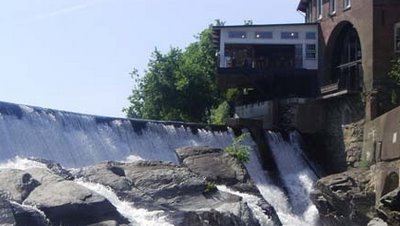
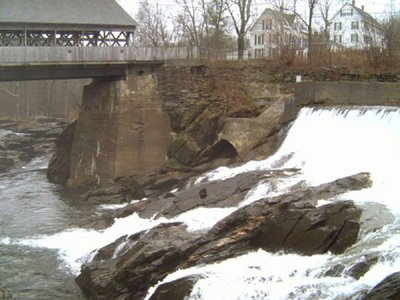
Of course, the receptionist didn't get the humour behind my mistake, which kind of made it more funny. R.'s stag party was held at the restaurant. It was certainly one of the more sedate stags I have attended, perhaps bettered in that respect only by my own. The wedding itself was lovely, held at R.'s bride's parents' beautiful house, up a dirt track in the Vermont forest. I was really glad I went.
1. Stuart Pearce - England football hero and punk rocker, a.k.a. "Psycho".
2. Simon Pearce - A refined eatery in Vermont with one of the most spectacular views I have ever experienced in a restaurant.
Of course, the receptionist didn't get the humour behind my mistake, which kind of made it more funny. R.'s stag party was held at the restaurant. It was certainly one of the more sedate stags I have attended, perhaps bettered in that respect only by my own. The wedding itself was lovely, held at R.'s bride's parents' beautiful house, up a dirt track in the Vermont forest. I was really glad I went.
Fighting gooks, gu-gus, Japs, sand niggers and towel heads
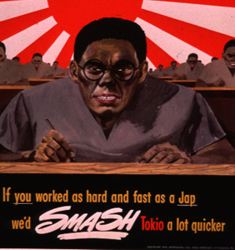


The combination of racism and war invariably leads to horrific brutality on all sides. In my narrow area of interest, I have always been uncomfortable with the popular idea of generally well behaved Allied soldiers fighting uniformly barbaric Japanese soldiers in World War Two. This stinks of raw wartime propaganda to me. There were atrocities on both sides, and many many more by Allied soldiers than it is usual to admit. (Eg.)
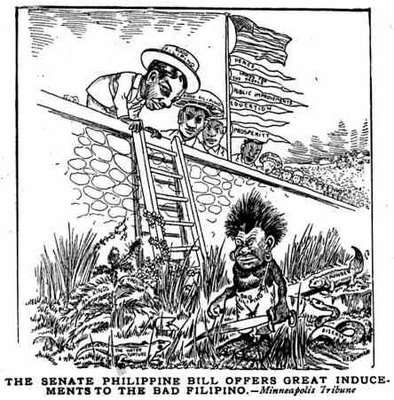
Anyway, that is just a largely unresearched gut reaction on my part. This, however, is a very detailed examination of racism in the Philippine-American War, 40 years before World War Two. The article is about a specific point in US imperial and racial history. Generalising beyond that context is dangerous. The more I read, though, the more I saw broader insights and lessons.
General MacArthur declared in a December 1900 proclamation. “Mankind, from the beginning of civilization, however, has tried to mitigate, and to escape, as far as possible, from the consequences of this barbarous conception of warlike action...” [89] The Filipinos, in refusing these boundaries, had shown themselves to be less than “civilized.” “The war on the part of the Filipinos,” wrote Secretary of War Elihu Root, “has been conducted with the barbarous cruelty common among uncivilized races.”In the context of such rhetoric, the war quickly became racist and brutal on both sides.
In 1902, for example, Albert Gardner, in Troop B of the 1st U.S. Cavalry, composed a would-be comic song dedicated to “water-cure” torture—in which filthy water was poured into the mouths of Filipino prisoners, drowning them--sung to the tune of the Battle Hymn of the Republic:It was common to compare the slaughter of Philippinos to game hunting:
1st
Get the good old syringe boys and fill it to the brim
We’ve caught another nigger and we’ll operate on him
Let someone take the handle who can work it with a vim
Shouting the battle cry of freedom
Chorus
Hurrah Hurrah We bring the Jubilee
Hurrah Hurrah The flag that makes him free
Shove in the nozzel [sic] deep and let him taste of liberty
Shouting the battle cry of freedom. [93]
Private George Osborn of the 6th Infantry wrote home from Negros on January 15, 1900: “Just back from the fight. Killed 22 niggers captured 29 rifels [sic] and 1 shotgun and I tell you it was a fight… we just shot the niggers like a hunter would rabbits."Souvenir photography was commonplace:
Photographs of dead Filipino soldiers lying in trenches were often taken by U. S. soldiers and journalists and included in commemorative albums. Albert Sonnichsen wrote in his memoir of the “heaps of dead and dying natives… photographed by our people, and exhibited with such mottoes as: ‘Can the __d Regiment boys shoot? You bet they can. Count the dead niggers.’”Atrocities were explained away in racial terms:
Henry Cabot Lodge in an address before the Senate: "I think I know why these things have happened. I think they have grown out of the conditions of warfare, of the war that was waged by the Filipinos themselves, a semicivilized people, with all the tendencies and characteristics of Asiatics, with the Asiatic indifference to life, with the Asiatic treachery and the Asiatic cruelty, all tinctured and increased by three hundred years of subjection to Spain."We have come along way from that type of public rhetoric (they had not come so far in 1945), but have we left the terrible intersection of racism and war behind? (1, 2, 3)
Reading:
Race over Empire - Racism and U.S. Imperialism, 1865-1900 by Eric T.L.Love
The Blood of Government: Race, Empire, the United States, and the Philippines by Paul A. Kramer
War Without Mercy: Race and Power in the Pacific War by John W. Dower
Tuesday, May 30, 2006
More national anthems

Since 2003, the Tokyo Metropolitan Government has been ordering schools to stand and sing the national anthem in their ceremonies and has disciplined teachers who have refused. It is part of a more general conservative push to foster nationalism in children which has prompted at least one elementary school to rate children's patriotic feelings on a three point scale in their reports.
All of which garners a few intemperate votes, I am sure, but, if you were genuinely wanting to encourage national feelings in children, would you force them to stand a sing the national anthem in assemblies. Would you really? Maybe at elementary school, it might work for a few of the slower souls. But in High School? Think about it.
The rather predictable consequence has been the spread of parodies, which sound like the national anthem and look like it when you are mouthing the words in assembly, but have various less patriotic meanings. Some of the versions currently being circulated appear to have been written by adults but, lets face it, for every teaspoon of adult derision, there will be a bucket full of sniggering teenage ridicule. That is how young people respond to old buffoons. Thank God.
Not sure what this parody, using English words, means (it sent the rightist Sankei Shinbun bonkers) but it makes more sense that the policy:
Kiss me, girl, your old one.Haunting. Christians are also using their own alternate lyrics to avoid Emperor idolatory (in the patriotically divided UK, of course, forcing Christian worship has been the equivalent of this Japanese nationalist push). The resistance is allowing the rightists to scream and shout even more, which I suppose is all they wanted to do in the first place.
Till you’re near, it is years till you’re near.
Sounds of the dead will she know ?
She wants all told, now retained,
for, cold caves know the moon’s seeing the mad and dead.
Nationalistic Effort: 3/3 Nationalistic Attainment: 0/3
Indoor Aerobatics
My interest in remote control planes has, until now, been limited. It is still limited. For 2 minutes 30 seconds, though, this held my attention.
Sunday, May 28, 2006
God Save the Queen
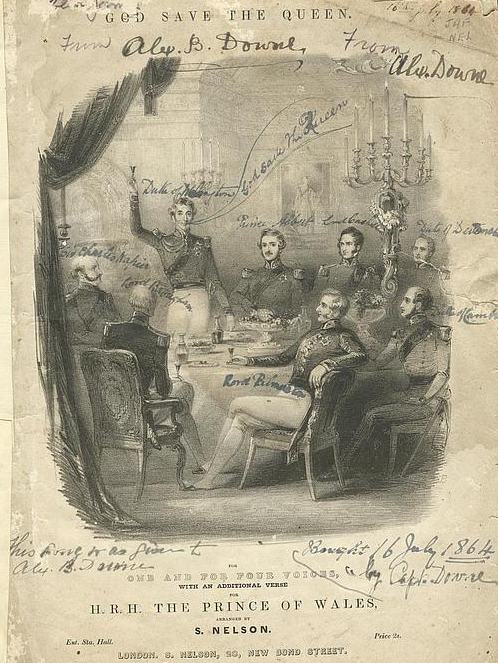
You know those times when you make some startling claim to someone and they are startled and then you start to wonder whether your startling claim was infact startling because it was totally untrue. Well, last week I told A's Dad that the UK national anthem was shared by another country. A.'s Dad was surprised, perhaps a little doubtful, so I looked it up today.
In fact, more than one state has shared the British National Anthem, and we're not just talking colonies. Liechtenstein is the country I was thinking of. When the English played Liechtenstein in a footy match a few years ago they had to play it twice. The German state also adopted the same tune between 1871 and 1918. Before that, the Prussians had used it. It was the official Russian national song between 1815 and 1833 and it has also been the melody to patriotic songs in the US (My Country, 'Tis of Thee"), Iceland, Switzerland and Sweden. It is Norway's Royal anthem. For example, here it is in Russian: "The Prayer of the Russians".
Strange that such a dirge-like tune should be so successful. Sounds better in that sexy Russian.
Sleeping in
Had a great lie-in today. I lay curled up in my futon listening to the screams and screeches of A. trying to cope with a rampant G. in the next room. Not a thimble full of guilt. Just a delicious feeling of selfishness. Eventually, A. could take it no more: "Chris, It's been two hours! Can't you get up?" I stayed in my little cotton cocoon for another five or so minutes, simulating A.'s simmering irritation in my head until it was just ready to boil over. Grudgingly, I emerged. As I shuffled toward the screeching, I glanced at my watch, wondering whether there was any morning left to waste. It was 7.56 am.
Friday, May 19, 2006
Unlucky for some

I'm not really a superstitious type but the fact that my parking space is numbered 13 sometimes gives me pause for thought on the morning of one of my course's numerous exams. In England, 13 might have been skipped. Here, things are different:

Fourteen is considered unlucky because it contains the number 4 (which my car park also misses out). One pronunciation of 4 is "shi", which is a homonym for death in Japanese.
More on triskaidekaphobia and tetraphobia.
Tuesday, May 16, 2006
Temptation Blocker

Maybe it's only me? Have you ever sat down at the computer full of determination to work yourself to the bone only to find yourself frittering away hours fiddling with everything but what you are supposed to be doing? If so, "Temptation Blocker" is the application for you.
It is free and it lets you block selected applications from yourself for defined periods of time. I just tried it and it seemed to work smoothly. After you download, a few applications will be added to the blockable list automatically but you may have to go to the "add new program" menu item and browse for your particular softspot.
One problem is that the blocker does not block websites selectively, just the whole browser, which may make some types of work difficult. A possible solution would be to download a second browser (say Opera) for work, without all the non-work bookmarks and passwords on your normal browser.
Saturday, May 13, 2006
Subscribe to:
Posts (Atom)