Tuesday, May 17, 2005

Oishinbo


I've picked a manga called "Oishinbo" as my reading after making a promise to myself not to read English books in my spare time here. From past experience, I know that they tend to spill over into time I should be spending studying Japanese.

Anyway, after a bit of feeling around, "Oishinbo" has been selected. It is about food. The basic plot is two young journalists working for the "Tozai" newspaper are assigned to search for the most delicious foods in the world. Each little story is a gourmet adventure. It quite makes your mouth water. It is aimed at adults and has been serialised for about 20 years, an indication of its popularity. I am reading the first volume and it is striking how this manga was campaigning against factory produced food and for fresh produce such a long time ago.

Two decades later, it is still difficult to get organic/free range stuff in Japanese supermarkets.

Posted by Hello

Sunday, May 15, 2005

The big city


The rather stern looking founder of Waseda University, Okuma Shigenobu Posted by Hello

On Saturday, A. had a study group to attend at Waseda University. I went along with her. While she was working, I nosed around Waseda, which is both a district of Tokyo and the home of the well known Uni. It is full of second hand bookshops and shabby cheap restaurants.

You wouldn't describe the university itself as beautiful, although it is pleasant enough, but it does have that feel of raw energy that some places have. Every railing is covered in posters for some club or society or other. One noticeboard was smothered in surreal photos taken by some over zealous student of his girlfriend. There was extracurricular activity everywhere. (A. says Waseda is famous for this.)

In one of the university's squares, I came across four students practicing a modern drama piece. When they were not in quiet and earnest discussion about their choreography, they were bellowing out their lines across the campus (video may take some time to load). It seemed to be the most normal thing in the world. Even the security guard helping a bus reverse into the square didn't bat an eyelid.

Friday, May 13, 2005

The rubbish may be rubbish but the baths are bathalicious


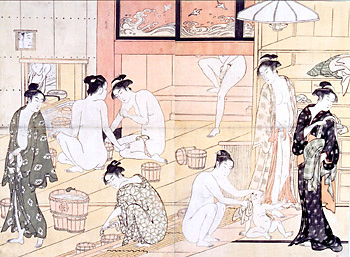
After an early morning spent at the waste disposal centre, the stressed housewife can retire to the "o-furo" for a nice relaxing soak.

The "o-furo", or bath, is a bit of an institution in Japan. In fact, bathing has been central to Japanese culture for hundreds of years. Back when Europeans preferred an earthier perfume, the Japanese sentou or public bath had a similar social function to the English pub: a meeting place where you could pass the soap to your neighbours, have a game of Japanese chess, or just a good chinwag with your mates. The Japanese phrase "hadaka no tsukiai" literally means naked companionship, but is an idiom for a friendship where nothing is hidden. In the period before modernisation (pre-1867), Tokyo had about 600 sentou within the city limits. In 1964, there were 23,000 nationwide. That has now declined to fewer than 10,000, mainly because of the increase in the number of o-furo in private homes. You tend to find older people if you visit a sentou nowadays, which is a bit sad. Like the decline of the traditional English local, I suppose.


What has survived, however, are the rituals of bathing. You must not enter the bath proper without first washing yourself thoroughly. This is a bit counter intuitive at first but the logic is clear if you are going to be sharing the water with others in a public setting. In Japanese homes, it is still usual for the water to be covered after use (with that white rolled-up thing on the right of the picture) and used by other members of the family. Anyway, you sit on the little stool (bottom left) and thoroughly soap yourself in the tiled area outside the bath. You then shower it all off (the whole room is tiled, like an enormous shower) and, clean as a cucumber, you plunge into your bath. The tub is deep. The water is piping hot. The washing is over. So, all you can do is relaaaaax.

For the true bathaholic, there is always the onsen to be visited, but that is another story.

Thursday, May 12, 2005

The rubbish is rubbish


Before leaving England, I uttered various blasphemies against the Gods of Waste Disposal. I would like to repent.

The cause of my indignation in England was Cambridge Council's decision to reduce its collections from one a week to once a fortnight, using the excuse that this would encourage more recycling. They had a box in which you could put all your recycleable rubbish. In my ignorance, I said their changes had nothing to do with environmentalism and everything to do with cutting one of the only real services they provided to us.

I now live in waste disposal purgatory. As Dante would have it, "a school of love designed to correct the erroneous". Here we must sort our rubbish in our own homes into six different categories: plastic bottles, plastic with the recycleable "purakuru" mark, burnable rubbish, non-burnable rubbish, cardboard milk boxes and tin cans. There are many collections a week (Hooray!) but each collection is for only one of these types of rubbish (Oh dear!), which means that one must go out almost daily with a little bag of one of these rubbish categories to the communal collection site. There is no house collection of garbage. Oh no! It is all collected from a central area and this area is not the same for each category. It is up the hill for purakuru and placky bottles and non burnable rubbish but down the hill for burnable stuff. By the way, if anybody ever thought of cheating, all rubbish is put in see-through bags so the guilty can be easily identified. And, I nearly forgot, the rubbish can only be taken to the collection area between 7 am and 8.30 am on the morning it is to be collected. Not before. Not after.

A conspiracy theorist would have it that this little detail is a rather good way, given the long commute times into Tokyo, of ensuring that housewives and bigdopeyhouseforeignerhusbands must stay at home instead of getting jobs. That of course is a conspiracy theory and not fair but when you are in Waste Disposal Purgatory your mind tends to wander and entertain the strangest imaginings.

Wednesday, May 11, 2005

Hanko


I've got my "hanko" back! A hanko is a small, three inch high seal which everybody here uses for signing official documents and suchlike. Makes one feel very medieval! I used to have one during my last sojourn in Japan but had to give it in to my office when I left. I asked for the same design on this one, which is my first name carved in the English alphabet in a swirly, slightly Sixties-ish font. I remember being very pleased with it when I first stepped foot on these shores. I used to put it on the inside cover of all my books. Very adolescent of me. Its reappearance is a blast from the past.

Tuesday, May 10, 2005

Shimamura Stores


Yesterday, G. and I went on a big expedition over the hill behind our house to Shimamura Stores, the local supermarket. I've already gone in one notch on my belt and I think a few more trips to Shimamura's should get me quite trim. I was intrigued by the selection of cocoas on offer. Not only does Mr Shimamura have your ordinary bog standard drinking chocolates but he has "sesame seed cocoa" (centre) and "black soya bean cocoa" (left, as you look at it). A. tells me it is considered healthy to take sesame and soya and suchlike in this form as a non-meat protein supplement. Must try it. Suppose Ovaltine or Horlicks might strike a foreigner as strange in the UK.

Monday, May 09, 2005

Not sure I'm getting...

...the full housewife experience. This was today's food parcel, which just arrived mysteriously on the doorstep. Who is my benefactor?

Sunday, May 08, 2005

Japanese mothers' day


Today was mothers' day here. We visited the graves of A's grandmums and great grandmums. In total, we went to three different graveyards. This one, the graveyard of A's mum's family was particularly beautiful. I didn't feel it was very respectful to go snapping loads of photographs but it was in a tree covered little valley. It was like visiting graves anywhere, plenty of weeding and flower arranging to be done. You also pour water on the gravestones themselves, which was new: a kind of ceremonial cleaning, I think.

Saturday, May 07, 2005

HQ

A few pictures of our house. It is in one of the suburbs of Hiratsuka, not really a walkable distance to the centre but there is a supermarket just over the hill and a convenience store a five minute walk away. In the medium term, a car is really going to be essential but it is not too bad at the moment just pottering around the locality.

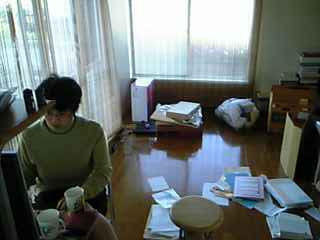
The house is lovely. There is a small garden which hopefully we can make something of and enough room for the three of us to live. Rather importantly, there is a substantial room which are going to use as a joint study. The desk is arriving on the 9th!


The lounge Posted by Hello


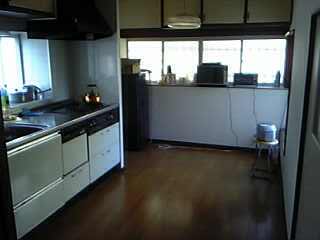
The kitchen Posted by Hello


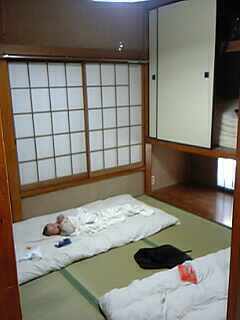
G's bedroom, which we are using too at the moment Posted by Hello


The study Posted by Hello


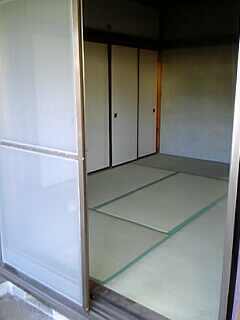
The Japanese room, the other bedroom Posted by Hello


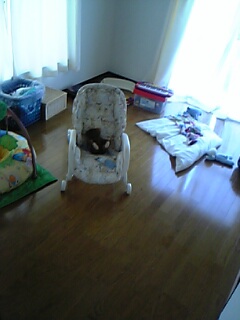
George's playroom Posted by Hello


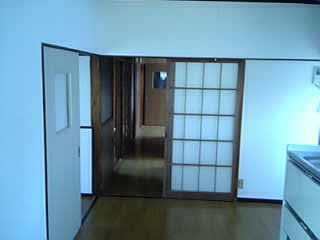
From the kitchen down the corridor (playroom on the first left, lounge second, tatami room third, my bedroom straight ahead, front door right at the end of the corridor) Posted by Hello

Monday, May 02, 2005

A new start

Following my move to Japan, my previously rather nerdish interest in blogging suddenly has a raison d'etre! I think it may be a good way of giving some visuals on how life is over here without bombarding people's email inboxes with reems of babble and blockbusting images. I can send images and text directly to the blog from my mobile so I should be able to do a little bit of a running commentary on my existence here. We shall see whether it works.

Friday, March 11, 2005

Slave walk in the city

Before coming to Japan, I walked into the City of London to try to track some of the addresses mentioned in Hochschild's book about the anti-slave trade movement. Below is a list of the main points on the walk. I have not organised them in any logical walking order. I did not walk in either the order I've given or in a logical manner.

For a map of the walk go here (it should open in a new window):


1. Old Jewry: The first office set up by the small group of men who decided to campaign against the slave trade was at 18 Old Jewry, at the heart of the City. It was rented for £25 a year. The street has other historical connections: there is a plaque commemorating the medieval synagogue that once stood there and from which it takes its name. There is no commemoration of the connection with the anti-slave trade campaign however. 18 Old Jewry no longer exists. Its place seems to have been taken by an access road beside an Allied Irish Bank building.

2. South Sea House: The South Sea Company, established in 1710, was based at 38 (or 37?), Threadneedle Street. Under the terms of the Treaty of Utrecht, Britain gained from France the right to supply slaves to the Spanish colonies. The South Sea Company was chosen to do it. A Royal Warrant in 1714 instructed the company to "charge themselves with the bringing into the West Indies of America belonging to the said King of Spaine in the space of thirty years therein mentioned one hundred four thousand such negroes as are therein described at the rate of four thousand eight hundred such negroes in each of the said thirty years." The company was permitted to import more slaves than this if the demand was there and "introduce, sell and dispose of the said negroes" without extra duties.

3. St Mary Woolnoth, Lombard Street: The church has a monument to John Newton, who was the Rector from 1779. He was a slave boat captain before he became a minister (see "Evil Aesthetes" below). He wrote the hymn "Amazing Grace". Some have annointed him as a leading anti-slave trade campaigner. Hochschild, however, points out that at no time during his decade on the slave ships or for thirty years afterwards did Newton show any sign of remorse for what he did, despite a marked tendency towards moralising on other matters. He did not come up with his first pamphlet "Thoughts upon the African Slave trade" until 1788, fully thirty years after he gave up slaving. In 1788, the anti-slavery campaign had begun to set the moral agenda and it seems the slaver turned prominent evangelical preacher started to feel the heat. As Hochschild says: "The curious thing, of course, is that for so long the slave trade apparently wasn't a subject of humiliating reflection for him at all. That Newton shuddered so is testimony to the way a strong social movement can awaken a conscience - even in a clergyman, whose very business is the awakening of consciences."

4. St Michael's Alley: "Triangle trade merchants and ship owners ... often gathered at the Jamaica Coffee House on St. Michael's Alley, said to have the best rum in London. Slave ship captains collected their mail there," says Hochschild.


This was in fact the site of London’s first coffee house, thriving before the slave boom. It was called the "Pasqua Rosee" when it opened in 1652 but was destroyed in the Great Fire of London (1666). A new coffee house was built two years later and it had a new name, referring to Britain's freshly acquired territory in Jamaica. It was used by slave traders not only as a place to discuss business but also to advertise slaves for sale or to announce runaways. On 8 August 1728, for instance, a two Guinea reward was offered at the Jamaica Coffee House for a black woman called Caelia Edlyne. (Incidentally, the Guinea coin itself was named after slave trade on the West African coastline.) The spot is now occupied by the Jamaica Wine House. There is a plaque to commemorate its history as the first coffee shop but I couldn't find anything on its connection with the slave business.

5. Africa House, 44-46 Leadenhall Street: The headquarters of the Royal African Company. In 1660 King Charles II gave the "The Company of Royal Adventurers" a royal charter. It was unsuccessful but was relaunched as the Royal African Company in 1672. Its main purpose was to develop the African slave trade. Its initials "RAC" were branded onto the chests of tens of thousands of slaves. The great philosopher and father of liberalism John Locke was a shareholder. The house in Leadenhall Street was pulled down in the 18th century to make way for the enlargement of the East India Warehouse in nearby Billiter Lane and in 1766 the RAC's offices were in Cooper's Court, Cornhill. They later moved later to 3 Suffolk Lane, Cannon Street.

6. George Yard: "Strangely, in a city where it seems that on almost every block a famous event or resident is commemorated by a blue and white glazed plaque, none marks this spot. All you can see today, after you leave the Bank station of the London Underground, walk several blocks, and then take a few steps into a courtyard, are a few nondescript office buildings, an ancient pub, and, on the site itself, 2 George Yard, a glass and steel high-rise. Nothing remains of the bookstore and printing shop that once stood here, or recalls the spring day more than two hundred yeas ago when a dozen people ... filed through its door and sat down for a meeting... Yet what these citizens began rippled across the world and we feel its after effects still," writes Hochschild. This was where, on May 22, 1787, at James Phillips bookstore and printing shop, the first meeting of the anti slavery movement was held. It was to grow into the first international human rights campaign and helped to revolutionise politics, civil society and the terms of international trade. The George and Vulture pub was there in 1787 and, given that it is just a few steps from the Jamaica Coffee House mentioned above, was probably packed with drunk slave traders. The two George Yard high rise was, until spring 2005, the main registered office of Barclays Bank, which is ironic because Barclays was founded on the slave trading profits of David and Alexander Barclay. Another irony is that the Barclays were Quakers: the Quakers were the first religious group to come out against slavery and provided much of the impetus for the early anti slavery campaign. Most of those present at the 1787 meeting were Quakers.

7. Philpot Lane: Number 17 was the base of Richard Oswald, one of the richest slave traders (see "Evil Aesthetes" post below). Other slave triangle traders had their headquarters on the same street. Today, it is a parade of dour buildings, including two Tandoori restaurants. One is called "Spice Trade". Perhaps the more historically accurate "Slave Trade" would have put customers off?

7. Custom House: repository of the red tape of the slave trade. Its records were used by the anti-slave trade campaigners to substantiate the cruelty of the trade.

8. Sugar Quay Walk - It is funny how London's docks are covered with tributes, in the names of roads and quays, to the various trades that built the city's fortune. But no reference to the slave trade! The sugar trade, the most profitable of all, was in fact one and the same thing as the slave trade. The boats that brought the slave grown sugar from the West Indies would then travel back out the Africa to pick up slaves and then make the deadly "middle passage", with slaves crammed in their holds, before returning to the mother country with the sweet stuff.

9. The Thames: "London Bridge ... barred tall masted ocean going [slave trade] ships from proceeding upriver; dozens of them would be docked or anchored there," says Hochschild. This is a painting of this part of the river from 1884, long after the abolition of the slave trade, but it gives a feeling of the scene:


It was a surreal experience trying to trace these landmarks of London's slave past. It is no exaggeration to say that much of London's present importance as a financial centre is, if you trace it back, founded on the slave and sugar trade. That incredibly profitable business built the capital that now gives this place its power.

I say it was a surreal experience because this extraordinarily powerful, energetic and impersonal nest of shiny office buildings does not relate to history in the way that most places do. If you come to Cambridge, for instance, history is given space both physically and in the story of the place. Cambridge has a linear narrative for the visitor and its historical artefacts occupy uncontested space, roped off for us to ponder the past and its continuity with the present. We can imagine people sitting in the same pub as us, centuries ago, and feel some kind of simple connection with them. The same is true of other parts of London: Buckingham Palace, Greenwich, even Whitehall and the Houses of Parliament. History makes sense there.

Trying to walk the same streets walked by the anti-slavery campaigners two centuries ago, in the centre of the City of London, is a much more disorienting experience. At one stage, as I left St Michael's Alley, my head was swimming. On the most basic level, I found virtually no commemoration of the slave trade. However, the disorientation came from something more than that: there was a feeling that these streets had no continuity with the past. They didn't have a linear narrative. Too much had gone on there over the centuries and too much was happening now. Too many millions of people, with too many backgrounds and competing thoughts in their heads had stepped on each paving stone. Hundreds of different stories ebbed and flowed across each inch of space. The City is a historical black hole, dense and full of energy. It doesn't really seem to want to have a story at all.

Monday, March 07, 2005

Slavery in art


While digging a bit deeper into a reference by Hochschild to J.M.W Turner's painting "Slavers Throwing Overboard the Dead and Dying. Typhon Coming On" (above), I was fascinated to discover that Emily Bronte's Wuthering Heights is believed by some to be filled with references to the slave trade. I had never even suspected such a link. Heathcliff comes from Liverpool and is persistently referred to as having a "swarthy" complexion. Is he a child of the slave trade? But, more interesting, did he himself become complicit in the trade during the time frame of the Novel? The author and academic Marina Warner says:

"...just before she died Angela Carter told me she was going to write an introduction to Wuthering Heights. She had a very interesting theory about what it was that Heathcliff had been up to. If you remember, Heathcliff goes away and comes back having made a fortune, and it takes place during this period we are talking about. One of the few things we know about Heathcliff is that he is found as a child in the Liverpool docks. Angela's theory was that, hidden in rather the same way as Turner approaches the story of the slave ship, and at the same time hides it under the paint, the Brontës similarly knew about slaving, they knew about the trade, they hinted at it in the Liverpool origin of Heathcliff, and this unexplained fortune that he brings back makes him feel damned. He says "I have sold my soul." Angela's theory was that he had sold his soul, that he was a black child, or half-black child – Brontë insistently calls him 'swarthy' – who had returned to Africa as a factor working for the British slavers, and done the trade, and that's how he'd made his fortune. This is hidden under the tempests, more tempests, the tempests of the novel. "


This was written in 1994, so I am obviously way out of date, but this was a bit of a revelation for my understanding of the novel. All that brooding soul-searching stuff suddenly seems a little bit less like romantic twaddle.

Society

Hochschild describes the the Caribbean slave economy as a "slaughterhouse". It was significantly more deadly than the horrific North American cotton plantations. The survivors of the 400,000 slaves brought to North America over the centuries had grown to a population of 4 million by the end of slavery there . The 2,000,000 slaves brought to the British West Indies left a surviving population of only 670,000 when the institution was abolished on those islands. Of course, many more than 1,330,000 people died because of the large numbers of children born to the slaves.

One of the biggest plantations on Barbados, at the centre of this mass murder (in which the usual punishment for rebellion was burning at the stake), was the Codrington estate. It was owned by an absentee landlord. But the absentee was not an individual:

"It was the Church of England.

Specifically, it was the church's missionary arm, the Society for the Propagation of the Gospel in Foreign Parts, whose governing board included the Regius Professors of Divinity at Oxford and Cambridge and the head of the church, the Archbishop of Canterbury. The estate's brand, burned onto the chests of slaves with a red-hot iron, was 'SOCIETY'."